I used to think scaling was mostly a sales problem. Get more leads, close more deals, hire a few more techs, and boom, you’re “growing.” It looks neat on a dashboard. It even sounds neat when you tell the story. Then you live it.
That’s the part a lot of MSP leaders don’t see coming. Growth can raise stress faster than it raises confidence. Your ticket volume climbs, your clients ask for “one more thing,” and your best people become your busiest people. Meanwhile you’re trying to keep service consistent, cash flow healthy, and culture intact, without turning into the bottleneck.
I’m Tiffany Bloomsky, President and CEO at Cortavo, an all-inclusive managed IT services provider based in Atlanta, founded in 2019 with a mission to simplify business IT and take the complexity off our clients’ plates. We’ve grown into the $7M range by treating “scale” as a leadership and operations challenge.
This piece isn’t about tools. I’m not here to argue RMM platforms or the “right” firewall brand. I’m here to talk about what makes scaling survivable and repeatable heading into 2026: culture, team, operations, and strategic mindset. And yes, we’ll also talk about MSP roll-ups.
What growth really feels like
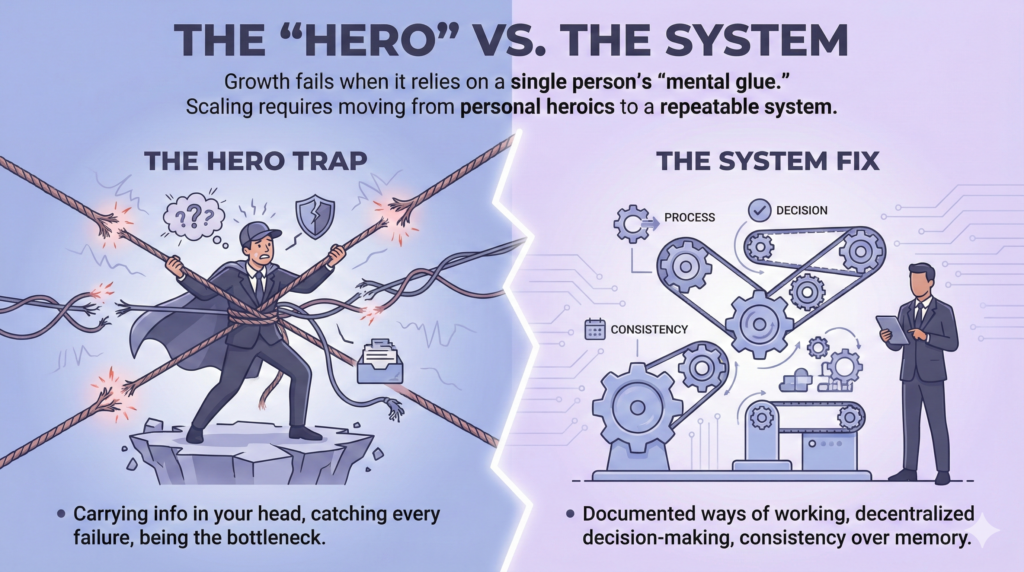
Scaling has a way of changing how you lead, even if you don’t set out to change anything. Early on, you can carry a lot in your head: which client hates meetings, which tech can calm down the toughest situation, which invoices need a nudge, and what corners you can cut “just this once” to keep things moving. For a while, that kind of mental glue holds the business together.
Then you hit a size where that approach starts to strain. “I’ll just handle it” turns into a quiet failure point, because the business is asking for consistency it can’t get from one person’s memory and availability. The job shifts from catching everything yourself to building a way of working that holds up when you’re not in the middle of it.
There’s also an honest emotional piece here: being the hero feels good. You jump in, fix it fast, and everyone breathes again. The downside is that it teaches the company to lean on your mood, your judgement, and your bandwidth, which means the whole operation gets shakier as you get busier.
And that’s why the CEO “sets the tone” isn’t just a saying. People take cues from you in small moments: how you react when something breaks, how you talk about a tough client, whether you stay calm when the week gets heavy, and whether bad news is safe to bring to the surface. If you’re steady and clear, the team usually gets steadier too, and you end up with a business that can grow without everyone constantly bracing for impact.
Why my background helped me scale
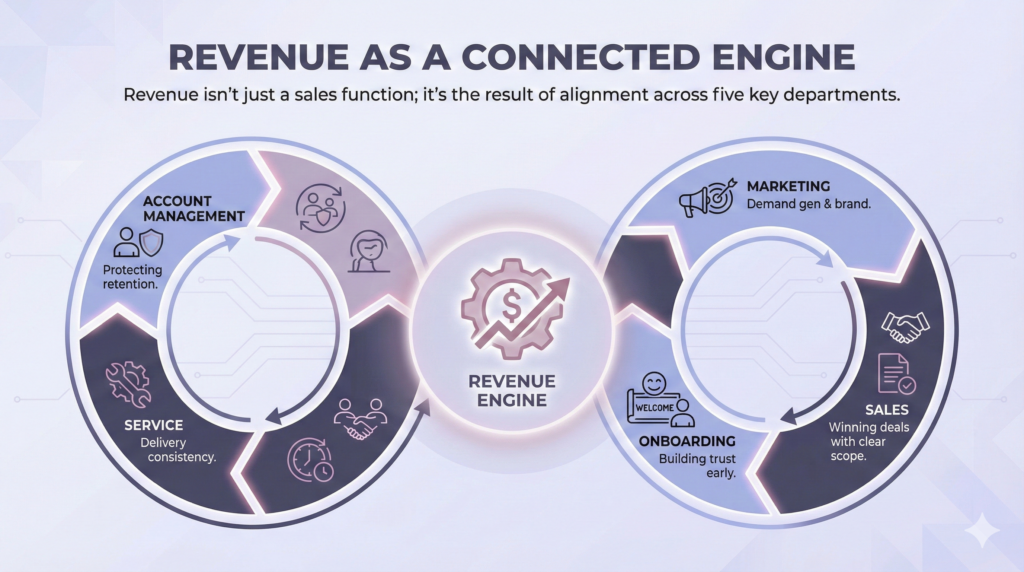
A lot of MSP CEOs come up through engineering, and I have a lot of respect for that path, but my route into leadership looked different. I’ve spent most of my career on the go-to-market and operations side: revenue ops, cross-department alignment, branding, demand generation, pipeline health, and customer experience. It’s the kind of work that can sound a bit abstract until you’re trying to scale and realise you can’t solve a broken business system with better tools alone. At Cortavo, that shows up in how I spend my time: setting strategic direction, working closely with every department, and building a revenue engine that actually supports customer success.
That lens shapes how I think about managed services. Growth only works when delivery can keep up, marketing only pays off when retention is strong, and culture shows up in every client interaction whether you meant for it to or not. The pieces lean on each other, so when one starts slipping, you feel the strain across the whole business pretty quickly.
Leadership lessons from scaling
Stop being the hero
Early growth rewards hero behaviour in a way that can feel addictive: you jump in, rescue the situation, solve the problem fast, and everyone is relieved. The team is grateful, the client calms down, and you get that immediate sense that you’re keeping the whole thing moving.
But once the business hits a certain size, that same pattern starts working against you. What used to be “leadership” becomes a bottleneck, and the company’s ability to move ends up tied to how available you are in a given moment.
When I catch myself wanting to jump in, I ask a question that stings a bit: am I solving this because it’s the best move, or because it makes me feel needed? If it’s the second one, I slow down. I look for the system fix.
This doesn’t mean you stop jumping in completely. You will, and sometimes you should. The difference is how you show up: not as the rescuer, but as the person who looks at the pattern and changes the system behind it.
And that includes your own habits. If every decision has to run through you, it can feel like you’re being “needed,” but it quietly trains the business to lean on you. Over time, that makes everything more fragile than it needs to be.
Revenue is everyone’s job
If sales is winning and delivery is drowning, that’s not a delivery issue. That’s leadership letting two worlds drift apart. I come from revenue ops, so I’ll say it plainly: revenue is not “what sales does.” Revenue is what happens when marketing, sales, onboarding, service, and account management are connected and honest with each other.
MSPs can accidentally create complexity just by moving fast. You promise a little too much to win the deal, onboarding turns into a rush, and a handful of loose ends get waved off with “we’ll sort it after go-live.” Then after go-live shows up, you’re paying for every shortcut with noise, rework, and frustrated people.
We’ve had to tighten up what we sell and how we deliver it: define the work clearly, standardise the repeatable parts, and treat recurring pain like data, not bad luck. When the same problem keeps resurfacing, it’s pointing to the operating model. Solve that, and the tickets start shrinking on their own.
Culture is your quality control
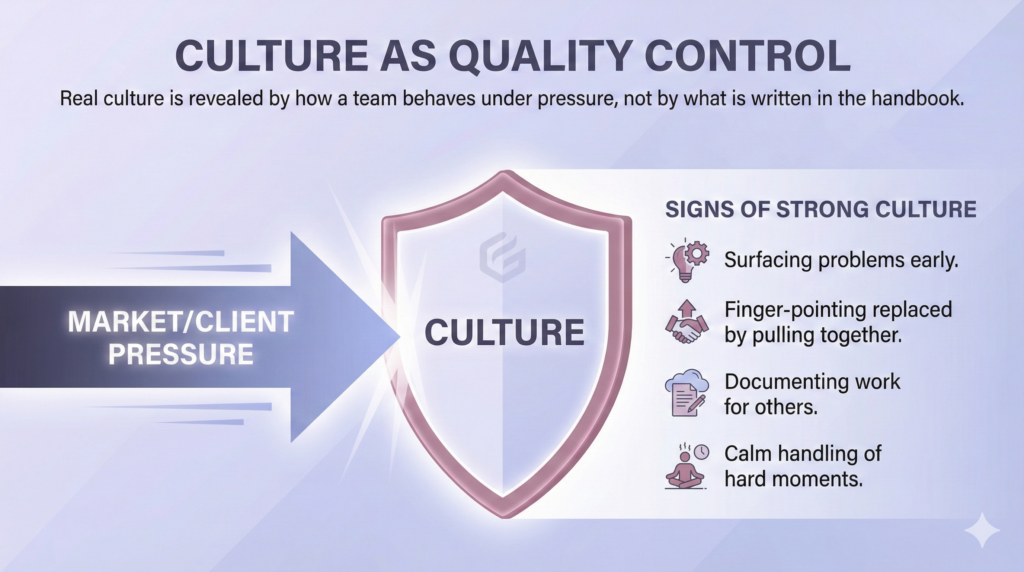
You don’t really see culture in the easy weeks. You see it when things get tense: a client is frustrated, a tech is running on fumes, and a project is slipping. In those moments, the real questions show up fast. Do people raise issues early or try to bury them until they get worse? Do they point fingers or pull together? Do they document what happened so the next person isn’t guessing, or do they rely on “I’ve got it” and hope it holds?
That day-to-day behaviour is culture, and it becomes your quality control as you scale. Cortavo has been recognised locally for workplace culture, and I’m proud of that, not for the award itself, but for what it usually signals: when the pressure’s on, the team still communicates clearly, treats each other with respect, and protects the client experience instead of letting stress run the room.
I’ll add one personal layer too. As a woman leading in tech, I’ve learned that consistency lands harder than volume. People aren’t looking for a big performance from leadership; they want steadiness, clear expectations, and a calm way of handling hard moments. When that’s the tone at the top, the team can do better work without feeling like they’re constantly bracing for the next fire.
Where to focus for 2026
A few shifts are stacking up at the same time. Clients are getting pitched “AI” nonstop, security expectations keep rising, more buyers want fewer vendors to manage, and consolidation is reshaping who you’re competing against. If I were helping an MSP founder map out 2026, I’d keep the plan anchored in a handful of fundamentals that hold up no matter what the buzzword of the month is.
Predictability is a product
Most clients aren’t asking for perfection. They’re asking for consistency. They want to know what happens when something breaks, what’s included, how fast you respond, and whether your team feels stable enough to trust long-term. When the relationship feels predictable, renewals get easier because there’s less anxiety in the account.
Predictability helps your team too. Clear standards, clear scope, and a consistent way of working reduce the “what are we walking into today?” feeling. The more everything becomes custom and improvised, the more tense the work gets, even when everyone is talented.
AI and automation
AI isn’t a magic trick, and most MSPs don’t need to build a whole department around it. What you do need is a sensible way to use it without letting it turn into chaos. Your team is going to use AI tools either way, so the real decision is whether you guide that use or leave it to chance.
For us, the practical approach looks like this: clear rules for what can and can’t go into AI tools, a straightforward process for testing new tools before rolling them out, and an expectation that outputs get checked the same way you’d check a junior tech’s work. If you don’t set that tone, the loudest voice will, and it’s usually a vendor deck.
Security
Security has become part of what clients buy when they hire an MSP, even if you never wanted it to be your headline offer. The best way to handle that is calm clarity: explain risk in plain language, set expectations, document decisions, and help clients make tradeoffs without theatrics.
The MSPs that win long-term don’t scare people into action. They make clients feel informed and protected.
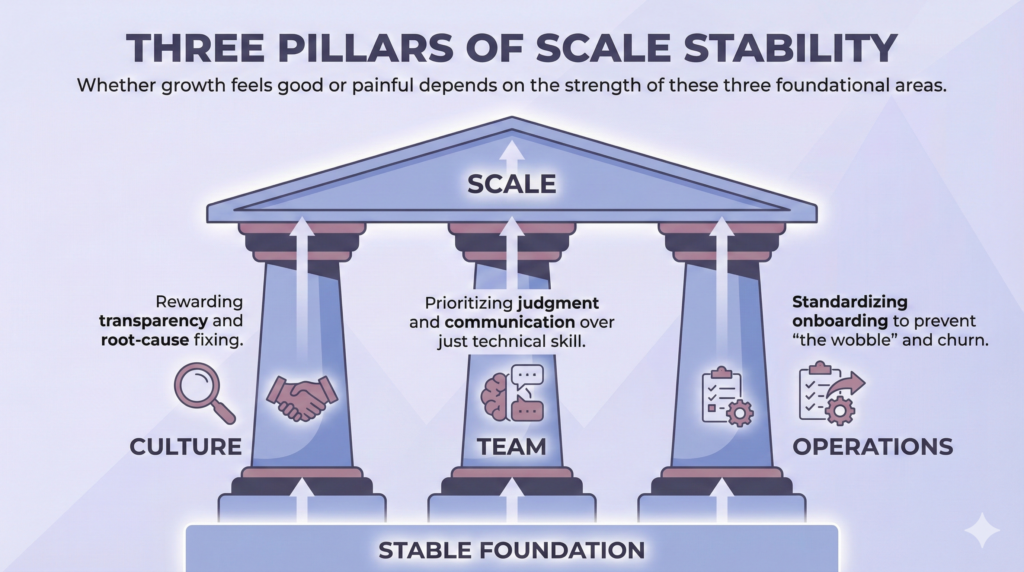
The basics that decide whether growth feels good or painful
When scaling feels chaotic, it’s usually a sign the business is running on individual heroics instead of a clear operating model. Three areas tend to decide whether growth gets easier or heavier: culture, team, and operations.
Culture
Culture is what people do when the pressure’s on. It’s the habits that show up in the middle of a messy week: surfacing problems early, documenting work, fixing root causes, and treating clients and teammates like humans.
If you want culture to improve, pay attention to what leaders reward and what they let slide. People don’t follow the handbook; they follow what gets praised, repeated, and protected.
Team
Technical skill matters, but judgement is what keeps service steady as volume increases. You want people who can explain tradeoffs without ego, write notes someone else can actually follow, stay calm with frustrated clients, and learn without turning everything into drama.
When techs feel replaceable, turnover climbs, training becomes constant, and service quality takes the hit. Clients notice, and the cycle repeats.
Operations
Onboarding is where trust gets built or lost. If it relies on a few key people who “just know how it works,” scale will expose that fast. A healthy onboarding motion is simple and consistent: clear steps, clear ownership, real timelines, and documentation that doesn’t live in someone’s head. It’s not glamorous work, but it prevents the wobble that turns into churn later.
Growth channels for 2026
If I’m planning growth for 2026, I’m choosing channels that build trust and show up in a measurable pipeline.
SEO still matters, but discovery isn’t only happening through Google anymore. Prospects ask AI tools for recommendations and explanations, which is why GEO/AEO is worth paying attention to: it’s about structuring your content so it’s easy to pull from and easy to cite. If you want a primer, GEO (AEO) Companies for eCommerce explains the idea well, even though it’s aimed at eCommerce. When I’m evaluating providers or approaches, I also like scanning how the market positions itself; a list like eCommerce SEO Agencies in the USA can be a useful reference point. And if you’re curious about the “AI visibility” layer, CiteMET AI is an interesting read on how content can circulate inside LLM workflows.
Paid can work, but it shines a spotlight on weak offers. If positioning is fuzzy or follow-up is slow, paid turns into expensive noise. Outreach still works when it sounds like a real person wrote it: short, specific, and grounded in an actual point of view. Directories and sponsorships tend to be lower priority unless you can track pipeline cleanly. I’d rather invest in partners, since partner-driven growth usually brings better-fit clients and smoother delivery.
MSP consolidation and roll-ups
If you run an MSP, you’ve felt the consolidation pressure. Deals happen quietly, competitor names change overnight, and those “are you open to a conversation?” emails land in your inbox more often than you’d like. Consolidation isn’t slowing down; it’s getting more structured.
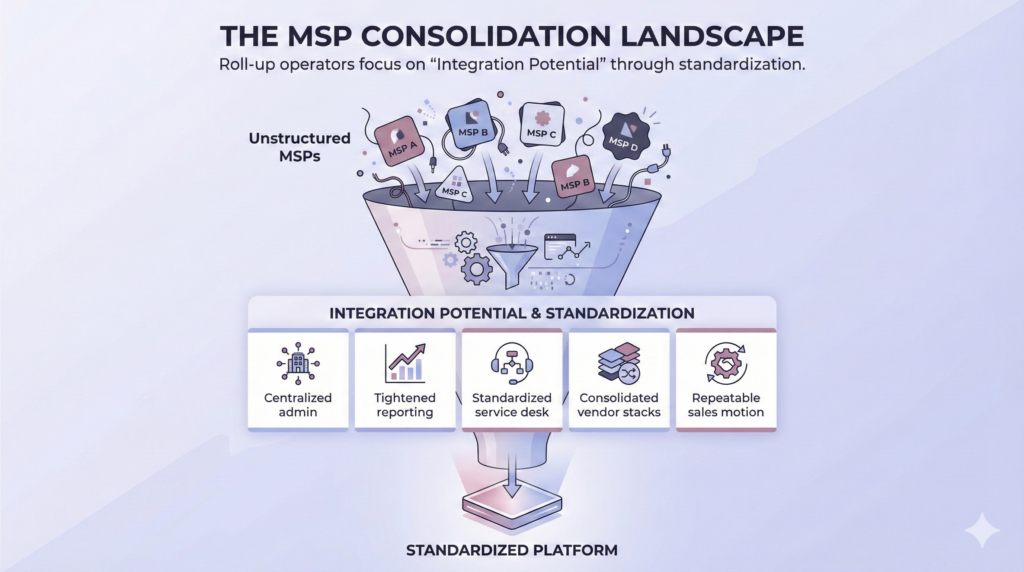
CRN reported that The 20 MSP completed 40 acquisitions in under three years and framed a model built around standardisation on a shared stack and process discipline. That’s a useful clue into how roll-up operators think: they’re not just buying revenue, they’re buying integration potential.
The next wave of MSP consolidation
The next wave will reward whoever can integrate well. Buying is the easy part; integration is where value gets created or burned. Expect more emphasis on standard operating models, reporting discipline, tool rationalisation, and shared delivery standards. The deals that work usually come with clear rules and fast decisions right after close.
What consolidation means for customers, teams, and leadership
Customers mostly care about one thing: does service stay steady? Some consolidations genuinely improve coverage and depth. Others make the experience colder and more rigid. If the relationship still feels safe, customers usually adapt.
For teams, bigger platforms can bring structure and clearer career paths, but culture shock is real. New managers, new KPIs, and new processes can either create stability or push good people out.
For C-level, consolidation can mean liquidity and relief, but it can also mean less control and real earn-out pressure. That part doesn’t get talked about enough.
What the roll-up operators are actually doing
Most operators are building leverage through standardisation: centralising admin functions, tightening finance and reporting, standardising service desk workflows, consolidating vendor stacks, and creating a repeatable sales motion. When it works, the platform feels cleaner and more consistent. When it doesn’t, it feels like a corporate layer that strips away what made the MSP special.
There’s a real tension here: some MSPs truly need structure, and consolidation can improve service for them. If your culture and client experience are your edge, though, you need to be careful about handing that edge to a machine that doesn’t value it.
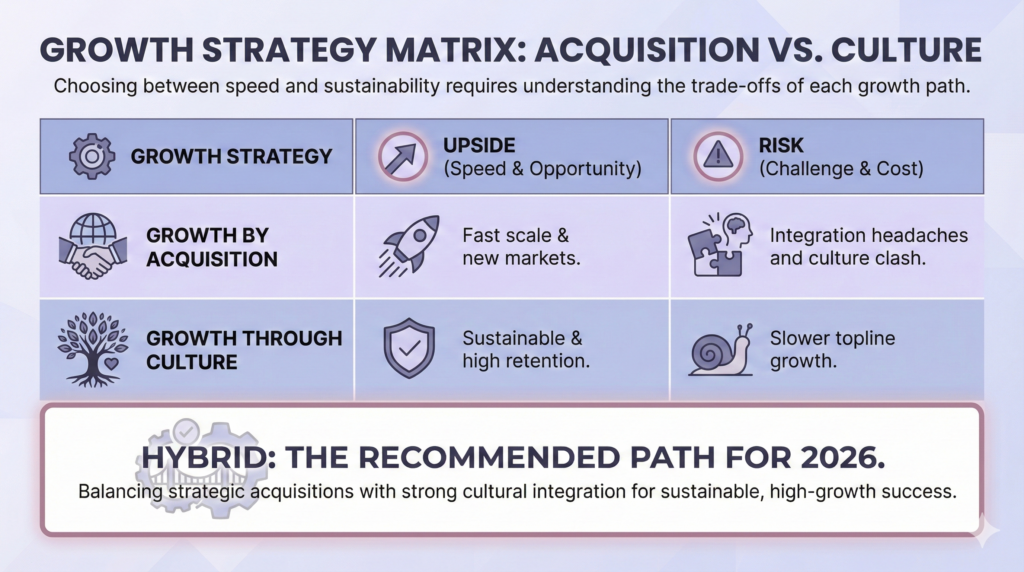
Growth by acquisition vs. growth through culture
Acquisitions can drive fast growth and real synergies: new geography, new talent, vertical expertise, vendor consolidation, buying power. They can just as easily bring integration headaches and churn if the basics aren’t solid.
Culture-led growth is slower, but it tends to stick. It improves retention, strengthens referrals, and makes the business easier to run over time.
Most MSPs will land somewhere in the middle in 2026: build real strength through culture and operational discipline, then stay open to acquisitions when the fit is clean. The warning is simple: don’t buy problems you haven’t solved inside your own walls, because shaky onboarding and messy operations don’t get better when you multiply them.
| Approach | Best for | Typical upsides | Typical risks | What to get right first | When it works best |
| Growth by acquisition | Fast scale, new markets, capability jumps | New geography, new talent, vertical expertise, vendor consolidation, buying power, cross-sell opportunities | Integration headaches, culture clashes, client churn, staff turnover, tool sprawl, inconsistent delivery | Documented delivery standards, repeatable onboarding, clean tool stack, clear service catalogue, strong account management | You can integrate within 60–120 days without service disruption, and the target’s clients and team match your operating model |
| Growth through culture | Sustainable scale, consistency, long-term retention | Higher retention, stronger referrals, better execution, calmer operations, easier hiring and training | Slower topline growth, requires patience and leadership consistency | Leadership alignment, hiring standards, training plans, feedback loops, performance clarity, clear values in action | You’re improving margins and service quality quarter over quarter, and your team can absorb growth without breaking |
| Hybrid (culture first, selective M&A) | Most MSPs aiming to scale in 2026 | Steady organic growth + occasional step-change wins | Buying too early can magnify internal weaknesses | Culture + operational discipline first, then a simple, repeatable integration playbook | You only acquire when the fit is clean and your fundamentals are already working |
Conclusion
As MSPs head into 2026, the firms that scale well won’t be the ones chasing every trend. They’ll be the ones that know exactly what they deliver, how they deliver it, and why clients should trust them as they grow. That means a tight service offering, non-negotiable delivery standards, and an operating model that stays consistent when volume increases. It also means investing in a culture and leadership approach that keep expectations clear, decisions calm, and quality stable under pressure.
Consolidation will keep shaping the market, whether you plan to buy, sell, or stay independent. The point isn’t to force a move; it’s to make a deliberate one, grounded in your fundamentals and your goals.
When you build your plan for next year, use one practical test: if your MSP doubled overnight, would clients experience more confidence and consistency or would they notice delays, handoff issues, and uneven execution? The answer is your roadmap, showing what needs to be strengthened before growth turns from opportunity into strain.
FAQs
Who is higher, CEO or CTO?
The CEO is accountable for the whole company: direction, performance, people, and outcomes. The CTO leads technical direction and standards. In MSPs, the CTO often protects how delivery works, while the CEO protects what business you’re building and how it runs.
What is the role of CEO in an IT company?
The CEO sets direction, builds leadership, protects the operating model, and ensures the company can deliver consistently while it grows. In managed services, that means balancing client experience, security expectations, financial health, hiring, retention, and positioning.
Who is the best tech CEO?
It depends on context. “Best” varies by industry, company stage, and goals. For MSPs, the most useful lens is whether a CEO can keep quality steady while growth increases.